loading

Tag: astrology

đź”® The Essential Zodiac Chart Interpreter: Deciphering Your Astrological Identity

Why Your Zodiac Chart is the Foundation of All Astrology

Have you ever wondered what makes an Aries an Aries or a Pisces a Pisces? The answers lie in the zodiac chart.

Your zodiac chart is the fundamental wheel of twelve signs—the cosmic framework upon which all astrological analysis is built. While many people confuse it with a full natal chart (which includes the planets and houses), the zodiac chart is the essential first layer. It defines the 12 types of energy available to the universe.

Understanding your zodiac chart interpretation is the key to moving beyond generic Sun Sign descriptions and grasping the complex mechanics of your personality. This guide will clarify what the chart is, how it works, and how you can use it to better understand your relationships and daily life.

By the time you finish this article, you will have the core knowledge needed to look at any astrological sign and understand its motivation, its core drive, and its role in the grand tapestry of horoscope astrology.


1. The Distinction: Zodiac Chart vs. Natal Chart


The terms zodiac chart and birth chart are often used interchangeably, but they represent two different levels of detail. To rank for this term, you must clarify the difference.

The Zodiac Chart (The Blueprint)


The zodiac chart is a fixed, ideal circle divided into 12 equal 30-degree sections, each named after a constellation. This chart represents the pure, fundamental energies of the cosmos.

  • Fixed: It never changes, regardless of where or when you were born.

  • Purpose: It defines the style of energy (e.g., Aries style is pioneering; Libra style is balancing).

The Natal Chart (The Personalization)


Your natal chart (or astro chart) takes the fixed zodiac chart and customizes it to your precise moment of birth.

  • Dynamic: It changes every minute and with every mile you travel.

  • Components Added: It adds the 10 moving planets and the 12 Houses of Experience. The positions of the Moon, Mercury, Mars, etc., are all placed within the context of the 12 zodiac signs.

Therefore, while the zodiac chart is the constant canvas, the birth chart is the unique painting created specifically for you. A true zodiac chart interpretation requires seeing how these 12 signs are activated by your personal planetary placements.


2. Decoding the 12 Astrological Signs (Elements and Modalities)


To master the zodiac chart, you must understand that the 12 signs are not simply random characters; they are structured logically according to two primary groupings: Elements and Modalities. Every astrological sign is a combination of one element and one modality.

The Four Elements (The Core Drive)


The elements define the fundamental temperament and psychological energy of the sign:

  • Fire Signs (Aries, Leo, Sagittarius): Drive: Action, passion, inspiration. Challenge: Impatience, ego.

  • Earth Signs (Taurus, Virgo, Capricorn): Drive: Stability, practicality, material security. Challenge: Resistance to change, materialism.

  • Air Signs (Gemini, Libra, Aquarius): Drive: Communication, intellect, social connection. Challenge: Detachment, overthinking.

  • Water Signs (Cancer, Scorpio, Pisces): Drive: Emotion, intuition, healing. Challenge: Moodiness, getting lost in feelings.

The Three Modalities (The Mode of Action)


The modalities define how the sign interacts with the world and expresses its elemental energy:

  • Cardinal Signs (Aries, Cancer, Libra, Capricorn): Mode: Starting, initiating, leading. These signs begin the seasons.

  • Fixed Signs (Taurus, Leo, Scorpio, Aquarius): Mode: Maintaining, stabilizing, consolidating. They are the fixed points of the seasons.

  • Mutable Signs (Gemini, Virgo, Sagittarius, Pisces): Mode: Adapting, changing, synthesizing. They transition the seasons.

A complete zodiac chart interpretation shows you that a Cardinal Fire sign (Aries) is an initiator of action, while a Fixed Water sign (Scorpio) is an emotion that maintains intensity.


3. Zodiac Chart Compatibility: The Fundamentals of Attraction


One of the most popular uses of the zodiac chart is for understanding relationships. Before diving into complex synastry, you must master the elemental foundation of zodiac sign compatibility.

Elemental Harmony and Conflict


The easiest way to determine initial zodiac chart compatibility is through the elements:

  1. Natural Harmony (Trine Aspect): Fire and Air complement each other (Air feeds Fire; Fire needs Air). Earth and Water complement each other (Water nourishes Earth; Earth contains Water). These connections flow easily.

  2. Natural Tension (Square Aspect): Fire clashes with Water and Earth. Air clashes with Water and Earth. While challenging, these tensions force growth and are often present in highly transformative relationships.

Polarity and Attraction


Every sign has a partner directly opposite it on the zodiac chart—its polar opposite. These opposites are 180 degrees apart and always share the same Modality and Element (e.g., both are Cardinal Air/Fire).

Polarity AxisTheme of Polarity
Aries – LibraSelf vs. Other / Action vs. Balance
Taurus – ScorpioResources / Value vs. Shared Wealth / Intimacy
Gemini – SagittariusDetails / Facts vs. Big Picture / Philosophy

Polarity represents a profound attraction because the other person has what you lack. It is essential for deep zodiac sign compatibility, though it requires constant integration and balance.


4. Translating the Signs: How Your Zodiac Chart Functions in Your Life


The zodiac chart interpretation extends far beyond simply knowing your Sun sign. It explains the energy behind everything you do.

The Three Pillars of Your Personality


While every astrological sign in your chart matters, three define your core identity:

  1. Sun Sign: The sign of your conscious identity (the ‘who’ you are).

  2. Moon Sign: The sign of your emotional needs and comfort zone (the ‘what’ you need).

  3. Ascendant/Rising Sign: The sign that defines your approach to life and your first impressions (the ‘how’ you interact).

Using the Signs for Your Daily Horoscope


The zodiac chart gives your daily horoscope its predictive power. The Moon transits through one sign every 2.5 days. Knowing the Moon’s sign on any given day provides actionable context:

  • Moon in Cancer: Daily Horoscope Focus: Home, family, cooking, emotional security. Action: Focus on nurturing tasks.

  • Moon in Capricorn: Daily Horoscope Focus: Career, structure, responsibility, authority. Action: Focus on long-term planning and professional tasks.

This is the practical application of zodiac chart interpretation: using the universal energy cycle to optimize your personal energy.

H2: Beyond the Basics: Planets in Detriment and Exaltation


A complete horoscope astrology analysis acknowledges that some planets operate better in certain signs than others:

  • Exaltation: The sign where a planet performs optimally (e.g., the Sun is exalted in Aries).

  • Detriment: The sign opposite the planet’s ruling sign, where its energy is challenged (e.g., Venus is in detriment in Aries).

Understanding these rules allows a birth chart reading to quickly identify both areas of innate strength and deep, necessary life lessons in your personality.


5. Your Next Steps in Zodiac Chart Interpretation


You now have the foundation for understanding the 12 energies. The next step is applying this knowledge to your personalized map.

To fully use this zodiac chart interpreter knowledge, you must merge it with the positions of the planets at your moment of birth. This is the difference between knowing the general rules (the 12 signs) and knowing your personal application (the full natal chart).

Resources for Deeper Understanding:


  • Get Your Free Chart: Use our easy tool to generate your personal free birth chart and see where the 12 signs land in your unique Houses

  • Master the Map: Read our Natal Chart Guide to understand how the planets and houses overlay this zodiac chart framework

  • Book an Analysis: If you are seeking professional insights into your horoscope astrology and complex chart placements, book a personalized reading today.
Book Appointment

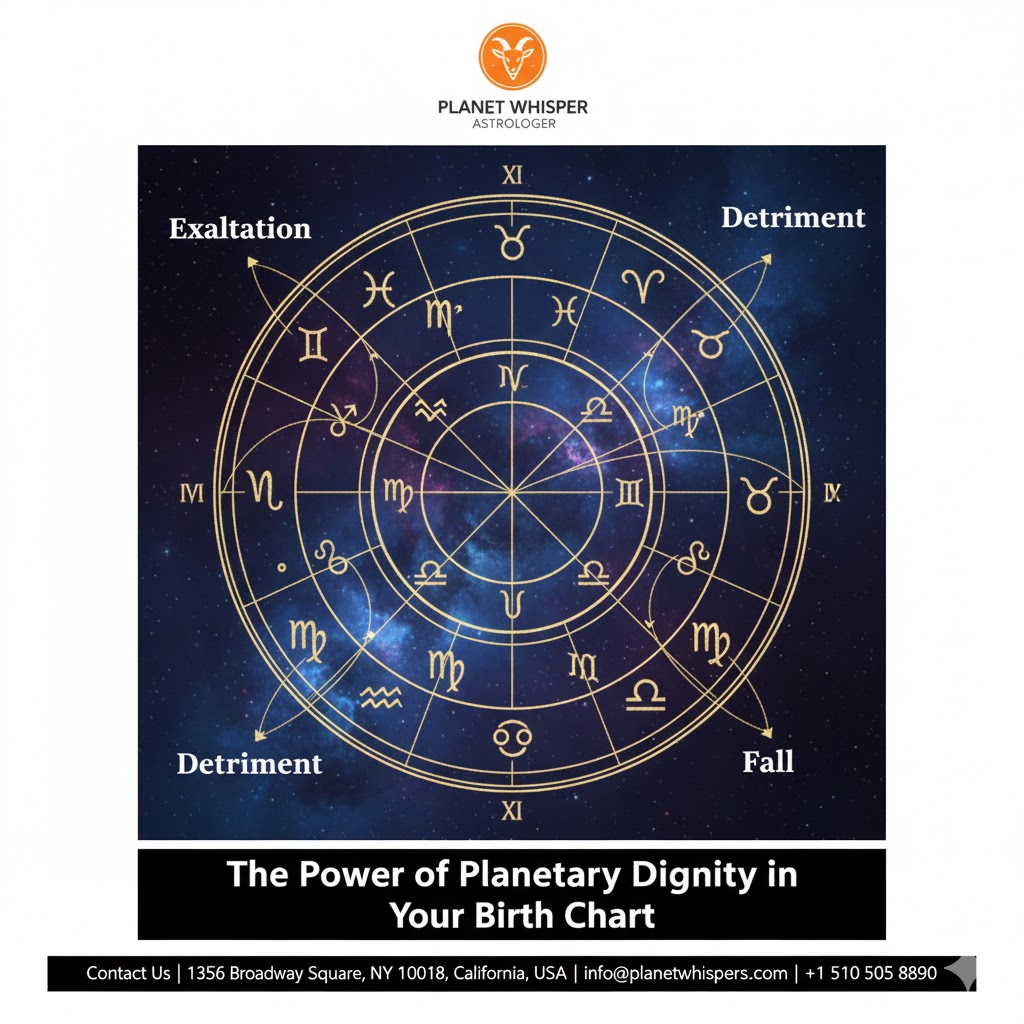
The Power of Planetary Dignity in Your Birth Chart

Beyond the Signs – Understanding Planetary Strength

Every single individual who has delved into the world of astrology knows their Sun sign. Many are also familiar with their Moon and Rising signs. But to stop there is to only scratch the surface of your natal chart’s complexity. The deeper, more nuanced meaning—the actual, tangible strength or struggle of a planet’s energy in your life—is determined by a concept known as Planetary Dignity.

The meaning of planetary dignity is simply this: it describes how strong, comfortable, and capable a planet is to express its fundamental nature, based entirely on the zodiac sign it currently occupies. Think of your birth chart not as a static painting, but as a grand assembly of cosmic dignitaries. A planet with high planetary dignity rules confidently like a king on his own throne; conversely, a planet with low planetary dignity, is in a foreign land, struggling to communicate, its powers dampened by an unfamiliar environment.

This concept is absolutely foundational for any serious student of astrology. If you want to move beyond generalized horoscopes and understand the true power levels of your chart—where your talents flow effortlessly and where life demands persistent effort—you must master the principles of planetary dignity. This extensive guide will not only define the four core states of dignity but also provide actionable steps on how to work with your strongest and weakest placements to maximize your inherent success and spiritual growth.

Why Planetary Dignity Is the Ultimate Astrological Secret


Why can two people with the same Sun, Moon, and Mercury placements still have wildly different life experiences? Often, the answer lies in dignity. Dignity offers a qualitative judgment on planetary influence:

  • A strong planet (high planetary dignity) brings ease, reliability, and confidence to the house it occupies. Its power is pure and simple to access.

  • A weak planet (low planetary dignity) brings complexity, friction, and doubt to its corresponding house. Its energy is convoluted, requiring patience and conscious maturity to utilize effectively.

Understanding planetary dignity allows you to tailor your life strategy. You learn where to lean for effortless support and where to roll up your sleeves and prepare for a rewarding, though difficult, mastery. Ultimately, this is the difference between working with the universe and fighting against its currents. The meaning of planetary dignity essentially provides the operating manual for your cosmic engine.

The Four Pillars of Planetary Dignity: Strength and Weakness


Planetary dignity is rooted in the traditional relationships between the seven classical planets (Sun, Moon, Mercury, Venus, Mars, Jupiter, Saturn) and the signs they rule. These relationships define two states of strength (Dignity) and two states of weakness (Debility). Recognizing these is the first step toward advanced chart interpretation.


I. States of Essential Strength (High Dignity)


These placements reveal where a planet is at its happiest and most effective. They are the “superpowers” of your natal chart.

1. Rulership (Domicile): The Planet Is at Home


A planet is in Rulership when it resides in the sign it naturally governs. This is the ultimate expression of planetary dignity and the strongest possible placement.

  • Core Concept: The planet is wearing its own clothes, speaking its native language, and making all the rules in its own domain. In fact, its energy flows purely, predictably, and powerfully. It expresses its nature without interference.

  • Classic Examples: Mars in Aries (Mars rules Aries), Venus in Libra (Venus rules Libra), Mercury in Gemini (Mercury rules Gemini).

  • Case Study: Mars in Aries. Mars is the planet of action, drive, and initiation. Aries is the sign of the assertive, pioneering self-starter. Consequently, when Mars is in Aries, your drive is authentic, direct, and uninhibited. Your actions are authentic and effective.

  • Life Effect: This area of life (the house it occupies) often brings reliable success and confidence, because the energy needed is always available and used properly.

2. Exaltation: The Planet Is Honored and Revered


A planet is in Exaltation when it is placed in a sign where it receives great honor and recognition. It’s like a highly revered guest receiving a state welcome.

  • Core Concept: The planet is incredibly strong and effective, often achieving great things. It can sometimes be amplified or dramatic, nonetheless the results are impressive.

  • Classic Examples: The Sun in Aries, Jupiter in Cancer, Saturn in Libra.

  • Case Study: Jupiter in Cancer. Jupiter is expansion, luck, and fortune. Cancer is nurturing, home, and emotion. Therefore, Jupiter’s exaltation here means that expansion and luck are often found through domestic life, real estate, family businesses, and emotional generosity. This placement offers immense financial and emotional security.

  • Life Effect: This area of life is where you shine publicly and gain recognition. The energy is powerful, though it might occasionally feel “too much” (e.g., Jupiter’s expansion can lead to overindulgence).


II. States of Essential Weakness (Low Dignity)


These placements reveal where a planet struggles, feels uncomfortable, or operates with inhibited energy. These are the areas where you must build mastery through conscious effort.

3. Detriment (Exile): The Planet Is Out of Place


A planet is in Detriment when it is placed in the sign directly opposite to its rulership. This is the environment that is most alien and least supportive of the planet’s basic function.

  • Core Concept: The planet feels confused and awkward, as the sign forces it to operate using the energy of its opposite. It has its energy, consequently the expression is clumsy, reluctant, or even antagonistic to its true nature.

  • Classic Examples: Mars in Libra (opposite Aries), Venus in Aries (opposite Libra), Mercury in Sagittarius (opposite Gemini).

  • Case Study: Venus in Aries. Venus seeks peace, harmony, and connection. Aries focuses on self-assertion, conflict, and independence. As a result, this planetary dignity placement often brings friction to relationships (7th House matters), where the urge for peace is constantly overridden by the need for self-assertion. The lesson here is learning to assert needs harmoniously.

  • Life Effect: This area of life often requires extra work, conscious effort, and maturity to master. The energy tends to feel difficult or frustrating until you learn to integrate the conflicting demands of the planet and the sign.

4. Fall: The Planet Is Undermined and Unsupported


A planet is in its Fall when it is placed in the sign directly opposite to its exaltation. This is the deepest state of unease for a planet.

  • Core Concept: The planet feels profoundly unsupported or powerless, as if standing on shaky ground. It struggles to stand up straight and properly fulfill its purpose, thus leading to deep feelings of vulnerability or inadequacy in that area of life.

  • Classic Examples: The Moon in Scorpio (opposite Taurus), Jupiter in Capricorn (opposite Cancer), The Sun in Libra (opposite Aries).

  • Case Study: The Moon in Scorpio. The Moon rules comfort, security, and emotions. Scorpio demands intensity, secrecy, and transformation. Therefore, the Moon’s Fall here means the native finds it difficult to feel secure without diving into psychological depths, leading to deep emotional complexity.

  • Life Effect: This area of life reveals your deepest vulnerabilities or inadequacy. Mastering this placement requires finding unconventional ways to express the planet’s energy without needing external validation or traditional support.


🔑 Advanced Interpretation: Applying Dignity to the Whole Chart


Understanding the core meaning of planetary dignity is only the beginning. The real power comes from synthesizing this information with the Houses and Aspects.

1. Dignity and the House System


The house a dignified planet occupies becomes a true powerhouse in your life:

  • Dignified Planet in an Angular House (1st, 4th, 7th, 10th): When a planet is strong and in a house related to major life themes… its impact is amplified across your entire destiny. For example, Venus in Libra (Rulership) in the 7th House (Partnerships) indicates a powerful capacity for attracting and sustaining harmonious, equal relationships.

  • Debilitated Planet in a Cadent House (3rd, 6th, 9th, 12th): A weakened planet in a house related to learning or service might indicate initial struggles in those areas. However, Mercury in Pisces (Detriment/Fall) in the 9th House (Higher Education) suggests the native will ultimately master abstract or intuitive wisdom (Pisces).

2. Dignity and Aspects


The strength of a planet dramatically colors how it interacts with others:

  • Dignified Planet in a Trine (120°): This is pure luck and flow. Moreover, a dignified Venus trine a dignified Jupiter is an aspect of immense financial and relational grace. The abundance flows effortlessly.

  • Debilitated Planet in a Square (90°): This creates intense friction and challenge. A debilitated Mars (Action) squaring a debilitated Saturn (Structure) suggests actions are constantly blocked by hurdles. Nevertheless, overcoming it grants a rare and unique mastery.


đź’ˇ The Modern Rulers: Dignity in the Outer Planets


Although traditional astrologers developed the concept for the seven classical planets, modern astrologers apply these principles to the outer planets (Uranus, Neptune, Pluto) through the signs they co-rule:

  • Uranus: Rulership in Aquarius. Exaltation in Scorpio.

  • Neptune: Rulership in Pisces. Exaltation in Aquarius.

  • Pluto: Rulership in Scorpio. Exaltation in Pisces.

Understanding these modern dignities is key to interpreting the generational forces in your natal chart. For instance, Pluto in Scorpio (Rulership) in the 1980s and 90s gave that generation immense power for transformation, setting the stage for major cultural shifts.


🛠️ Working with Debilitated Placements: Transforming Weakness into Wisdom


The goal of learning the meaning of planetary dignity is not to despair over a planet in Detriment or Fall. These are not flaws; they are assignments. A planet in debility forces you to find a non-traditional, highly evolved way to express its energy, ultimately leading to profound mastery.

Three Steps to Planetary Mastery:


  1. Acknowledge the Friction: Understand the core conflict. If, for example, your Moon (Security) is in Scorpio (Fall), acknowledge that your safety mechanism involves deep emotional control. Stop fighting this complexity; accept it as your starting point.

  2. Use the Opposite Sign’s Wisdom: For a planet in Detriment, use the wisdom of the sign it rules. Specifically, if Mars is in Libra (Detriment), use Libra’s emphasis on harmony and strategy before initiating action. This integrates the necessary skill it lacks.

  3. Find the Spiritual Outlet: Debilitated planets often work best when channeled into humanitarian work, art, or service… This transforms the personal struggle into collective service.


 Your Dignity, Your Destiny


The power of planetary dignity in your birth chart is the ultimate key to personalized astrology. It moves your understanding from what your chart contains to how effectively you can wield your inherent cosmic energy.

Your dignified planets are your allies—the areas of life where you are naturally gifted and confident. Your debilitated planets are your teachers—the areas that demand maturity, introspection, and the development of unique, highly valuable life skills.

Ultimately, by recognizing the meaning of planetary dignity, you gain the ability to navigate your life with precision, confidence, and compassion, turning every astrological challenge into an opportunity for authentic mastery. Your destiny is not merely written; it is expressed through the dynamic power levels of your planets.

Astro Chart Essentials: The Meaning of the Ascendant

The Beginner’s Guide to Interpreting Your Astro Chart Houses

Align Your Life Why Personalized Astrology Services Are Your Roadmap to Destiny