loading

Tag: natal chart

  • Home
  • Tag: natal chart

🌙 Natal Chart Secrets: How Your Moon Zodiac Sign Impacts Your Daily Horoscope Forecast

Why Your Zodiac Sign is Only Half the Story

When you read your daily horoscope, you typically look up your Sun zodiac sign. However, to get a truly accurate moon sign daily horoscope, you need more. If your forecast consistently feels shallow, generic, or just plain wrong, you are experiencing the most common flaw in general horoscope astrology.

Your Sun sign reflects your conscious ego and willpower—the mask you wear for the world. However, your emotional reality and instinctive reactions are governed by your Moon zodiac sign.

The Moon is the fastest-moving celestial body in the natal chart, changing signs every 2.5 days. Because it controls your emotional landscape, it is the single most important factor for interpreting your daily horoscope with accuracy. This guide shows you why mastering your Moon zodiac sign is the key to unlocking the true power of your personalized daily forecast.


1. The Moon’s Domain: Emotion, Instinct, and Routine


 The Moon Zodiac Sign as Your Emotional Thermostat


Your Moon zodiac sign determines what you need to feel safe, secure, and nurtured. It dictates your emotional reaction to stress, your habitual responses, and your relationship with comfort (food, home, family).

Moon Sign ElementEmotional Response & NeedDaily Horoscope Implication
Fire (Aries, Leo, Sag)Needs excitement, action, and passion.Needs proactive advice; struggles with stagnation.
Earth (Taurus, Virgo, Cap)Needs stability, routine, and material comfort.Needs advice on work/finance; struggles with sudden change.
Air (Gemini, Libra, Aqua)Needs connection, intellectual stimulation, and objective discussion.Needs advice on social timing; struggles with intensity.
Water (Cancer, Scorpio, Pisces)Needs deep emotional connection, intimacy, and healing.Needs guidance on boundaries; struggles with detachment.

The Moon’s Daily Horoscope Influence: The Fastest Transit


The Moon transits all 12 zodiac signs every 28 days. This is the fastest, most palpable energy shift in your daily horoscope.

For example, when the Moon moves into an assertive sign like Aries, everyone feels a surge of motivation. However, if your Moon zodiac sign is Libra (Aries’ opposite), you might feel an emotional urge to seek peace and balance, leading to internal conflict. Understanding your natal Moon sign helps you manage this push-pull.


2. Reading Your Daily Horoscope Through Your Moon


A truly effective daily horoscope must consider the transits to your natal Moon because it rules your inner life.

The Trigger: Transits to Your Moon Sign Daily Horoscope Forecast


When a transiting planet makes an aspect (a geometric angle) to your natal Moon zodiac sign, it triggers an emotional response that dominates your daily horoscope.

  • The Jupiter Effect: When transiting Jupiter aligns with your natal Moon, the daily horoscope might feel expansive and hopeful. You might suddenly feel the urge to pursue a hobby or spend generously on comfort (as Jupiter expands the emotional drive of the Moon).

  • The Saturn Challenge: When transiting Saturn aligns with your natal Moon, the daily horoscope will feel heavy, restrictive, or melancholic. You are forced to deal with emotional responsibilities or boundaries (as Saturn restricts the emotional flow of the Moon).

Knowing your Moon zodiac sign (and its house placement in your natal chart) tells you exactly what kind of emotional issue today horoscope movements will trigger.

Practical Application for Every Moon Sign Daily Horoscope User


For a powerful daily horoscope reading, look at the current Moon zodiac sign and compare it to yours:

  1. Conjunction (Same Sign): If the transiting Moon is in your natal Moon zodiac sign, you experience an emotional recharge. It is a great day to focus on self-care and your core emotional needs.

  2. Square (90 Degrees): If the transiting Moon is squaring your natal Moon, you experience emotional friction and irritability. The daily horoscope advises you to avoid confrontation and seek solitude.


3. The Horoscope Astrology Synthesis: Moon and Sun Working Together


While the Moon rules your emotions, the Sun rules your conscious action. A complete horoscope astrology interpretation teaches you to use them in tandem.

Managing the Conflict Between Your Sun and Moon


Many people have their Sun zodiac sign in one element and their Moon zodiac sign in another (e.g., an assertive Aries Sun with a sensitive Cancer Moon). This can create an internal tug-of-war.

Your daily horoscope often highlights this conflict. For example, if your forecast encourages bold action (Sun energy) but the Moon’s placement suggests an emotional need for retreat (Moon energy), you must consciously find a compromise.

The Role of the Moon in Zodiac Sign Compatibility


The Moon is arguably more important than the Sun for long-term zodiac sign compatibility. Compatibility in daily life is built on shared emotional needs and routines.

  • If your Moon zodiac sign is incompatible with your partner’s Moon sign, you will constantly clash over domestic issues, handling stress, or even choosing how to relax.

  • Therefore, a professional birth chart reading should always examine the Synastry between two Moon placements before declaring compatibility.


Take Control of Your Emotional Forecast


Stop letting a generic Sun zodiac sign forecast leave you feeling disconnected. Your Moon zodiac sign is the key to unlocking the subtle, emotional undercurrents that truly define your daily horoscope. By tracking the Moon’s movement against your personal natal chart, you gain emotional foresight and stability.

If you are ready to move from guessing to knowing how each today horoscope truly affects you, you must personalize your forecast.
☄️ Beyond Your Zodiac Sign: Discovering the Power of Asteroids in Your Birth Chart

When you first learned your zodiac sign, you discovered the sun’s position—the core of your personality. Then, you looked at your Moon sign and Ascendant in your natal chart. But what if we told you there are thousands of other powerful celestial bodies? These asteroids are waiting to be decoded in your birth chart.

While the Sun, Moon, and 10 traditional planets are the main characters, the Asteroids add incredible psychological depth. Specifically, the “Big Four”—Ceres, Pallas, Juno, and Vesta—act as the supporting cast. They reveal intricate details about self-worth, wisdom, relationships, and spiritual focus. Consequently, a basic horoscope cannot touch these insights. This advanced guide moves beyond traditional zodiac sign limitations. It helps you unlock a more complex, nuanced self-understanding. By integrating the Asteroids, you transform a generic astro chart into a profound map of your subconscious drivers.


1. Why Asteroids Matter in Your Natal Chart


The major asteroids primarily orbit the Sun between Mars and Jupiter. They were discovered in the early 1800s. Significantly, this discovery coincided with a rise in feminist and psychological thought, and their meanings reflect themes often excluded from ancient patriarchal astrology.

H2: Bridging the Gap Between Planets and Deep Psychology


The Asteroids act as vital links between the personal, inner planets (Moon, Mercury, Venus, Mars) and the impersonal, collective outer planets (Uranus, Neptune, Pluto). They show the specific ways you internalize and express feminine power, healing, and commitment.

If you find that your relationship experiences don’t fully align with your Venus (love) or Mars (drive) placements, the Asteroids in your birth chart are likely filling in the missing details. Therefore, we must study them.

H2: Integrating the Asteroids with Your Zodiac Sign Energy


Every Asteroid is placed in a zodiac sign and a House in your astrology chart. Together, this interaction tells a precise story:

  • Asteroid: The specific psychological theme (e.g., healing, power, commitment).

  • Zodiac Sign: How you express that theme (e.g., compassionately, fiercely, intellectually).

  • House: Where that theme plays out in your life (e.g., career, home, relationships).

For example, if the asteroid Vesta (spiritual focus) is in your Cancer zodiac sign, you direct your sacred focus toward nurturing, home, and family security.


2. The Big Four: Decoding the Power of Ceres, Pallas, Juno, and Vesta


These four asteroids offer the deepest, most critical psychological insights in any birth chart reading.

H2: 1. Ceres: Nurturing, Loss, and Self-Worth


Ceres, named after the Roman goddess of agriculture and motherhood, governs nurturing, unconditional love, and the cycle of loss and grief.

  • Ceres in Sign: Shows how you nurture others and yourself. Ceres in an Air zodiac sign (like Gemini) shows nurturing through communication and ideas.

  • Ceres in House: Shows the area of life where you most need to feel nourished. Conversely, this is also where you deal with issues of abandonment and self-worth.

  • Core Lesson: You learn that giving and receiving must be balanced here.

H2: 2. Pallas: Wisdom, Strategic Power, and Inner Authority


Pallas Athene, the warrior goddess of wisdom, governs intelligence, strategy, artistic creativity, and non-physical combat.

  • Pallas in Sign: Shows your unique style of intellectual and strategic brilliance. Pallas in a Fire zodiac sign (like Aries) gives you tactical, assertive intelligence.

  • Pallas in House: Indicates the field where your pattern recognition and ability to create unconventional solutions are strongest.

  • Core Lesson: Here is where you find creative empowerment and fight for justice.

H2: 3. Juno: Commitment, Partnership, and Equality


Juno, the consort of Jupiter, rules commitment, marriage, and how we seek partnership. Importantly, this applies not just romantically, but in all significant one-on-one bonds.

  • Juno in Sign: Defines your needs and expectations within partnership (e.g., Juno in an Earth zodiac sign often seeks stability and material commitment).

  • Juno in House: Shows the area of life where partnership dynamics, power struggles, and the search for equality are most intensely played out.

  • Core Lesson: You learn to honor yourself while committing to another. Thus, this is crucial for analyzing zodiac sign compatibility.

H2: 4. Vesta: Focus, Dedication, and Sacred Service


Vesta, the Vestal Virgin, represents focus, spiritual dedication, ritual, and where you seek deep, unbroken inner peace.

  • Vesta in Sign: Shows the type of energy you dedicate yourself to. Vesta in a Water zodiac sign (like Pisces) dedicates itself to spiritual or intuitive service.

  • Vesta in House: Shows the area of life where you most likely practice sacred devotion. Alternately, this is where you need to retreat for internal sanctuary.

  • Core Lesson: You find wholeness and dedication through conscious separation or focus here.


3. Integrating Asteroids into Your Birth Chart Reading


How do these new players impact your existing understanding of your zodiac sign? Essentially, they provide the subtext that explains your subtle behaviors.

H2: Asteroids and Daily Horoscope Interpretation


While the big 10 planets drive major trends, understanding the Asteroids’ placements helps you interpret your emotional responses to those trends.

For instance, when Mars (action) transits over your natal Vesta (dedication), your daily horoscope might feel like a sudden surge of energy to dedicate yourself to a long-ignored project. Similarly, when Venus (relationships) transits over your natal Juno (commitment), your daily horoscope highlights themes of partnership negotiations.

H2: Moving from Sun Sign to Synastry


If you are struggling to understand why you are fiercely attracted to a partner who doesn’t seem to match your zodiac sign compatibility, look to your Asteroids. Often, your Juno placement is aligned perfectly with their Mars or Venus. This creates a powerful, irresistible karmic connection not visible in the Sun-Moon comparison.

A professional birth chart reading that includes these points offers a much more complete picture of birth chart love compatibility.


4. Your Next Step: Unlocking the Deeper Layers


This article has taken you far beyond the generalities of your zodiac sign. You’ve moved from the introductory map to a highly detailed, personalized blueprint.

If you are ready to stop skimming the surface of your astrology chart and utilize the wisdom of the Asteroids to improve your relationships, career, and self-worth, the next step is a deep consultation.

Ready to find out the story your Asteroids are telling?

  • Get Your Free Chart: Use our tool to generate my birth chart and see the basic placements of these four asteroids

  • The Deeper Dive: Learn more about how the 12 Houses define the arenas of your life in our definitive Natal Chart Guide 

  • Book Your Expert Analysis: Schedule a specialized birth chart reading today to have our astrologers interpret the Asteroids, aspects, and their powerful conjunctions with your zodiac sign placements.

🔮 The Essential Zodiac Chart Interpreter: Deciphering Your Astrological Identity

Why Your Zodiac Chart is the Foundation of All Astrology

Have you ever wondered what makes an Aries an Aries or a Pisces a Pisces? The answers lie in the zodiac chart.

Your zodiac chart is the fundamental wheel of twelve signs—the cosmic framework upon which all astrological analysis is built. While many people confuse it with a full natal chart (which includes the planets and houses), the zodiac chart is the essential first layer. It defines the 12 types of energy available to the universe.

Understanding your zodiac chart interpretation is the key to moving beyond generic Sun Sign descriptions and grasping the complex mechanics of your personality. This guide will clarify what the chart is, how it works, and how you can use it to better understand your relationships and daily life.

By the time you finish this article, you will have the core knowledge needed to look at any astrological sign and understand its motivation, its core drive, and its role in the grand tapestry of horoscope astrology.


1. The Distinction: Zodiac Chart vs. Natal Chart


The terms zodiac chart and birth chart are often used interchangeably, but they represent two different levels of detail. To rank for this term, you must clarify the difference.

The Zodiac Chart (The Blueprint)


The zodiac chart is a fixed, ideal circle divided into 12 equal 30-degree sections, each named after a constellation. This chart represents the pure, fundamental energies of the cosmos.

  • Fixed: It never changes, regardless of where or when you were born.

  • Purpose: It defines the style of energy (e.g., Aries style is pioneering; Libra style is balancing).

The Natal Chart (The Personalization)


Your natal chart (or astro chart) takes the fixed zodiac chart and customizes it to your precise moment of birth.

  • Dynamic: It changes every minute and with every mile you travel.

  • Components Added: It adds the 10 moving planets and the 12 Houses of Experience. The positions of the Moon, Mercury, Mars, etc., are all placed within the context of the 12 zodiac signs.

Therefore, while the zodiac chart is the constant canvas, the birth chart is the unique painting created specifically for you. A true zodiac chart interpretation requires seeing how these 12 signs are activated by your personal planetary placements.


2. Decoding the 12 Astrological Signs (Elements and Modalities)


To master the zodiac chart, you must understand that the 12 signs are not simply random characters; they are structured logically according to two primary groupings: Elements and Modalities. Every astrological sign is a combination of one element and one modality.

The Four Elements (The Core Drive)


The elements define the fundamental temperament and psychological energy of the sign:

  • Fire Signs (Aries, Leo, Sagittarius): Drive: Action, passion, inspiration. Challenge: Impatience, ego.

  • Earth Signs (Taurus, Virgo, Capricorn): Drive: Stability, practicality, material security. Challenge: Resistance to change, materialism.

  • Air Signs (Gemini, Libra, Aquarius): Drive: Communication, intellect, social connection. Challenge: Detachment, overthinking.

  • Water Signs (Cancer, Scorpio, Pisces): Drive: Emotion, intuition, healing. Challenge: Moodiness, getting lost in feelings.

The Three Modalities (The Mode of Action)


The modalities define how the sign interacts with the world and expresses its elemental energy:

  • Cardinal Signs (Aries, Cancer, Libra, Capricorn): Mode: Starting, initiating, leading. These signs begin the seasons.

  • Fixed Signs (Taurus, Leo, Scorpio, Aquarius): Mode: Maintaining, stabilizing, consolidating. They are the fixed points of the seasons.

  • Mutable Signs (Gemini, Virgo, Sagittarius, Pisces): Mode: Adapting, changing, synthesizing. They transition the seasons.

A complete zodiac chart interpretation shows you that a Cardinal Fire sign (Aries) is an initiator of action, while a Fixed Water sign (Scorpio) is an emotion that maintains intensity.


3. Zodiac Chart Compatibility: The Fundamentals of Attraction


One of the most popular uses of the zodiac chart is for understanding relationships. Before diving into complex synastry, you must master the elemental foundation of zodiac sign compatibility.

Elemental Harmony and Conflict


The easiest way to determine initial zodiac chart compatibility is through the elements:

  1. Natural Harmony (Trine Aspect): Fire and Air complement each other (Air feeds Fire; Fire needs Air). Earth and Water complement each other (Water nourishes Earth; Earth contains Water). These connections flow easily.

  2. Natural Tension (Square Aspect): Fire clashes with Water and Earth. Air clashes with Water and Earth. While challenging, these tensions force growth and are often present in highly transformative relationships.

Polarity and Attraction


Every sign has a partner directly opposite it on the zodiac chart—its polar opposite. These opposites are 180 degrees apart and always share the same Modality and Element (e.g., both are Cardinal Air/Fire).

Polarity AxisTheme of Polarity
Aries – LibraSelf vs. Other / Action vs. Balance
Taurus – ScorpioResources / Value vs. Shared Wealth / Intimacy
Gemini – SagittariusDetails / Facts vs. Big Picture / Philosophy

Polarity represents a profound attraction because the other person has what you lack. It is essential for deep zodiac sign compatibility, though it requires constant integration and balance.


4. Translating the Signs: How Your Zodiac Chart Functions in Your Life


The zodiac chart interpretation extends far beyond simply knowing your Sun sign. It explains the energy behind everything you do.

The Three Pillars of Your Personality


While every astrological sign in your chart matters, three define your core identity:

  1. Sun Sign: The sign of your conscious identity (the ‘who’ you are).

  2. Moon Sign: The sign of your emotional needs and comfort zone (the ‘what’ you need).

  3. Ascendant/Rising Sign: The sign that defines your approach to life and your first impressions (the ‘how’ you interact).

Using the Signs for Your Daily Horoscope


The zodiac chart gives your daily horoscope its predictive power. The Moon transits through one sign every 2.5 days. Knowing the Moon’s sign on any given day provides actionable context:

  • Moon in Cancer: Daily Horoscope Focus: Home, family, cooking, emotional security. Action: Focus on nurturing tasks.

  • Moon in Capricorn: Daily Horoscope Focus: Career, structure, responsibility, authority. Action: Focus on long-term planning and professional tasks.

This is the practical application of zodiac chart interpretation: using the universal energy cycle to optimize your personal energy.

H2: Beyond the Basics: Planets in Detriment and Exaltation


A complete horoscope astrology analysis acknowledges that some planets operate better in certain signs than others:

  • Exaltation: The sign where a planet performs optimally (e.g., the Sun is exalted in Aries).

  • Detriment: The sign opposite the planet’s ruling sign, where its energy is challenged (e.g., Venus is in detriment in Aries).

Understanding these rules allows a birth chart reading to quickly identify both areas of innate strength and deep, necessary life lessons in your personality.


5. Your Next Steps in Zodiac Chart Interpretation


You now have the foundation for understanding the 12 energies. The next step is applying this knowledge to your personalized map.

To fully use this zodiac chart interpreter knowledge, you must merge it with the positions of the planets at your moment of birth. This is the difference between knowing the general rules (the 12 signs) and knowing your personal application (the full natal chart).

Resources for Deeper Understanding:


  • Get Your Free Chart: Use our easy tool to generate your personal free birth chart and see where the 12 signs land in your unique Houses

  • Master the Map: Read our Natal Chart Guide to understand how the planets and houses overlay this zodiac chart framework

  • Book an Analysis: If you are seeking professional insights into your horoscope astrology and complex chart placements, book a personalized reading today.

Book Appointment

The Karmic Secrets Hidden in Your Natal Chart’s South Node

If your North Node represents your soul’s future destiny, understanding the meaning of the South Node is crucial, as it reveals where you have been.

The South Node, often called the Dragon’s Tail, is the point in your natal chart directly opposite the North Node. It is not about where you are going, but where you have been. It represents the sum total of your past lives, your deeply ingrained habits, your comfort zone, and the skills you have already perfected to the point of mastery.

While the South Node feels easy and familiar, it also represents a karmic debt or a limiting behavioral pattern that, if clung to, prevents your soul from evolving. Understanding the sign and house placement of your South Node is essential for releasing the past and fully embracing your destiny.

Ready to uncover the karmic secrets that have traveled with you across lifetimes? Let’s dive deep into the profound meaning of the South Node in your birth chart.


What Is the South Node? The Point of Comfort and Constraint


In astrology, the North and South Nodes of the Moon are not actual celestial bodies. They are mathematical points where the Moon’s orbit crosses the Earth’s path around the Sun (the ecliptic).

  • The North Node (Head of the Dragon): Your future; the difficult, necessary lessons.

  • The South Node (Tail of the Dragon): Your past; the easy, comfortable habits.

The South Node reveals the “low-hanging fruit” of your personality. These are the talents you mastered so well in past incarnations that you now unconsciously default to them.

The South Node’s Dual Role:


  1. The Talent Bank: It shows your innate, unearned skills. If your South Node is in Leo, you naturally attract attention and can perform effortlessly.

  2. The Karmic Trap: Because these skills are so easy, you revert to them whenever life gets tough, preventing you from developing the contrasting skills of your North Node. Clinging to the South Node creates stagnation and debt in this lifetime.

Understanding the meaning of the South Node is thus a spiritual imperative: you must honor its skills but consciously move away from its limitations.


1. The South Node by Sign: The Legacy of Past Life Traits


The sign of the South Node describes the fundamental traits and personality style you have perfected and must now leave behind to evolve.

South Node SignPast Life/Comfort Zone TraitsThe Karmic Trap (What to Release)
AriesSelf-reliance, independence, warriorship, action.Excessive selfishness, impulse, and conflict avoidance in relationships.
TaurusMaterial security, sensual enjoyment, stable resources.Stubbornness, attachment to comfort, financial stagnation, resistance to change.
GeminiSurface knowledge, communication, intellectual curiosity.Gossip, intellectual restlessness, lack of depth, inability to commit to one idea.
CancerNurturing, emotional security, family, tribal loyalty.Clinging to family/past, fear of the public, emotional dependency, moodiness.
LeoPerformance, leadership, romance, creativity.Excessive ego, need for constant applause, narcissistic focus, dramatic flair.
VirgoService, analysis, health, perfectionism, detail.Hyper-criticism, self-sabotage, obsession with routine, anxiety about control.
LibraPartnership, harmony, diplomacy, aesthetic beauty.Codependency, fear of confrontation, indecision, sacrificing self for others.
ScorpioIntensity, control, shared resources, psychological depth.Manipulation, distrust, obsession with debt/sex/power, inability to share resources.
SagittariusPhilosophy, truth, long travel, beliefs, freedom.Moralizing, self-righteousness, dogmatism, restlessness, running from commitment.
CapricornStatus, ambition, structure, public authority.Emotional coldness, excessive materialism, rigid tradition, fear of vulnerability.
AquariusDetachment, groups, intellect, humanitarianism.Emotional distance, intellectual arrogance, revolutionary chaos, avoiding deep connection.
PiscesCompassion, dreams, spirituality, empathy, surrender.Martyrdom, emotional fusion, victimhood, escapism, avoiding reality/boundaries.

2. The South Node by House: Where the Past Plays Out


The house placement of the South Node shows the specific arena of life where you feel the past pull most strongly and where you hold the greatest ingrained skill.

South Node HouseArea of Past Life Mastery/FocusKarmic Lesson (Where You Stagnate)
1st House (Self)Identity, outward persona, self-image.Obsession with self-image; must learn to focus on the partner (7th House).
2nd House (Money/Value)Personal income, resources, self-worth.Clinging to earned assets; must learn shared finances and transformation (8th House).
3rd House (Communication)Local knowledge, siblings, close connections.Relying on quick words/gossip; must seek higher meaning and belief (9th House).
4th House (Home/Roots)Family, emotional foundation, private life.Retreating into the past/home; must build a public reputation (10th House).
5th House (Creativity/Fun)Pleasure, romance, self-expression.Excessive focus on fun/ego; must serve groups and humanitarian ideals (11th House).
6th House (Service/Routine)Daily work, health, duties, efficiency.Obsession with routine/perfection; must embrace intuition and spirituality (12th House).
7th House (Partnerships)Marriage, one-on-one relationships, contracts.Dependency on a partner; must cultivate independent identity and action (1st House).
8th House (Shared Resources)Shared money, crisis, transformation, depth.Controlling others’ resources; must build personal security and resources (2nd House).
9th House (Beliefs/Travel)Philosophy, religion, higher truth, long travel.Dogmatic belief system; must engage in practical, immediate learning (3rd House).
10th House (Career/Public)Status, career, public reputation.Relying on status; must nurture private life and emotional roots (4th House).
11th House (Groups/Hopes)Friends, groups, collective vision, technology.Over-reliance on group acceptance; must express unique creative self (5th House).
12th House (Subconscious)Spirituality, solitude, escapism, hidden patterns.Retreating into fantasy/victimhood; must engage in daily service and reality (6th House).

How to Use the Meaning of the South Node for Evolution


The ultimate goal is not to destroy your South Node talents, but to redirect them. The South Node holds the fuel you need; the North Node provides the direction.

  1. Identify the Talent: Acknowledge the innate skill your South Node gives you. (e.g., South Node in Virgo gives you amazing analytical skills).

  2. Release the Trap: Identify the karmic trap (e.g., Virgo’s trap is crippling perfectionism or anxiety). You must consciously stop reverting to this pattern when stressed.

  3. Use the Skill, Serve the North: Redirect the South Node skill toward the North Node’s goal.

    • Example: South Node in Virgo (analysis, service) needs to move to North Node in Pisces (intuition, compassion). The native should use their sharp Virgo analytical skill to serve intuitive, compassionate, and spiritual ends—like becoming a therapist, energy healer, or spiritual counselor. The analysis supports the compassion, rather than crippling it.

By consciously moving toward the North Node’s destiny, you successfully integrate the past’s wisdom with the future’s challenge. This is the true path of karmic growth.

Astro Chart Essentials: The Meaning of the Ascendant

Align Your Life Why Personalized Astrology Services Are Your Roadmap to Destiny

Book Now

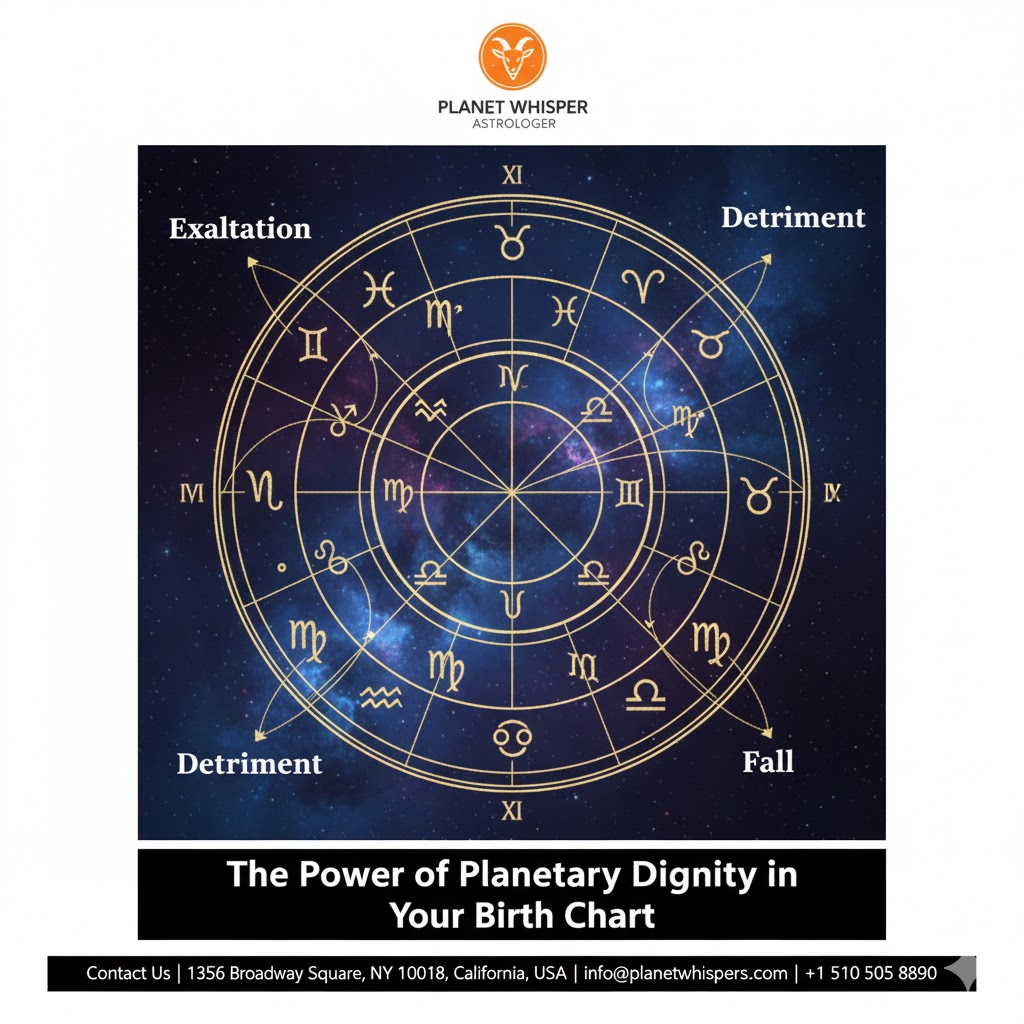
The Power of Planetary Dignity in Your Birth Chart

Beyond the Signs – Understanding Planetary Strength

Every single individual who has delved into the world of astrology knows their Sun sign. Many are also familiar with their Moon and Rising signs. But to stop there is to only scratch the surface of your natal chart’s complexity. The deeper, more nuanced meaning—the actual, tangible strength or struggle of a planet’s energy in your life—is determined by a concept known as Planetary Dignity.

The meaning of planetary dignity is simply this: it describes how strong, comfortable, and capable a planet is to express its fundamental nature, based entirely on the zodiac sign it currently occupies. Think of your birth chart not as a static painting, but as a grand assembly of cosmic dignitaries. A planet with high planetary dignity rules confidently like a king on his own throne; conversely, a planet with low planetary dignity, is in a foreign land, struggling to communicate, its powers dampened by an unfamiliar environment.

This concept is absolutely foundational for any serious student of astrology. If you want to move beyond generalized horoscopes and understand the true power levels of your chart—where your talents flow effortlessly and where life demands persistent effort—you must master the principles of planetary dignity. This extensive guide will not only define the four core states of dignity but also provide actionable steps on how to work with your strongest and weakest placements to maximize your inherent success and spiritual growth.

Why Planetary Dignity Is the Ultimate Astrological Secret


Why can two people with the same Sun, Moon, and Mercury placements still have wildly different life experiences? Often, the answer lies in dignity. Dignity offers a qualitative judgment on planetary influence:

  • A strong planet (high planetary dignity) brings ease, reliability, and confidence to the house it occupies. Its power is pure and simple to access.

  • A weak planet (low planetary dignity) brings complexity, friction, and doubt to its corresponding house. Its energy is convoluted, requiring patience and conscious maturity to utilize effectively.

Understanding planetary dignity allows you to tailor your life strategy. You learn where to lean for effortless support and where to roll up your sleeves and prepare for a rewarding, though difficult, mastery. Ultimately, this is the difference between working with the universe and fighting against its currents. The meaning of planetary dignity essentially provides the operating manual for your cosmic engine.

The Four Pillars of Planetary Dignity: Strength and Weakness


Planetary dignity is rooted in the traditional relationships between the seven classical planets (Sun, Moon, Mercury, Venus, Mars, Jupiter, Saturn) and the signs they rule. These relationships define two states of strength (Dignity) and two states of weakness (Debility). Recognizing these is the first step toward advanced chart interpretation.


I. States of Essential Strength (High Dignity)


These placements reveal where a planet is at its happiest and most effective. They are the “superpowers” of your natal chart.

1. Rulership (Domicile): The Planet Is at Home


A planet is in Rulership when it resides in the sign it naturally governs. This is the ultimate expression of planetary dignity and the strongest possible placement.

  • Core Concept: The planet is wearing its own clothes, speaking its native language, and making all the rules in its own domain. In fact, its energy flows purely, predictably, and powerfully. It expresses its nature without interference.

  • Classic Examples: Mars in Aries (Mars rules Aries), Venus in Libra (Venus rules Libra), Mercury in Gemini (Mercury rules Gemini).

  • Case Study: Mars in Aries. Mars is the planet of action, drive, and initiation. Aries is the sign of the assertive, pioneering self-starter. Consequently, when Mars is in Aries, your drive is authentic, direct, and uninhibited. Your actions are authentic and effective.

  • Life Effect: This area of life (the house it occupies) often brings reliable success and confidence, because the energy needed is always available and used properly.

2. Exaltation: The Planet Is Honored and Revered


A planet is in Exaltation when it is placed in a sign where it receives great honor and recognition. It’s like a highly revered guest receiving a state welcome.

  • Core Concept: The planet is incredibly strong and effective, often achieving great things. It can sometimes be amplified or dramatic, nonetheless the results are impressive.

  • Classic Examples: The Sun in Aries, Jupiter in Cancer, Saturn in Libra.

  • Case Study: Jupiter in Cancer. Jupiter is expansion, luck, and fortune. Cancer is nurturing, home, and emotion. Therefore, Jupiter’s exaltation here means that expansion and luck are often found through domestic life, real estate, family businesses, and emotional generosity. This placement offers immense financial and emotional security.

  • Life Effect: This area of life is where you shine publicly and gain recognition. The energy is powerful, though it might occasionally feel “too much” (e.g., Jupiter’s expansion can lead to overindulgence).


II. States of Essential Weakness (Low Dignity)


These placements reveal where a planet struggles, feels uncomfortable, or operates with inhibited energy. These are the areas where you must build mastery through conscious effort.

3. Detriment (Exile): The Planet Is Out of Place


A planet is in Detriment when it is placed in the sign directly opposite to its rulership. This is the environment that is most alien and least supportive of the planet’s basic function.

  • Core Concept: The planet feels confused and awkward, as the sign forces it to operate using the energy of its opposite. It has its energy, consequently the expression is clumsy, reluctant, or even antagonistic to its true nature.

  • Classic Examples: Mars in Libra (opposite Aries), Venus in Aries (opposite Libra), Mercury in Sagittarius (opposite Gemini).

  • Case Study: Venus in Aries. Venus seeks peace, harmony, and connection. Aries focuses on self-assertion, conflict, and independence. As a result, this planetary dignity placement often brings friction to relationships (7th House matters), where the urge for peace is constantly overridden by the need for self-assertion. The lesson here is learning to assert needs harmoniously.

  • Life Effect: This area of life often requires extra work, conscious effort, and maturity to master. The energy tends to feel difficult or frustrating until you learn to integrate the conflicting demands of the planet and the sign.

4. Fall: The Planet Is Undermined and Unsupported


A planet is in its Fall when it is placed in the sign directly opposite to its exaltation. This is the deepest state of unease for a planet.

  • Core Concept: The planet feels profoundly unsupported or powerless, as if standing on shaky ground. It struggles to stand up straight and properly fulfill its purpose, thus leading to deep feelings of vulnerability or inadequacy in that area of life.

  • Classic Examples: The Moon in Scorpio (opposite Taurus), Jupiter in Capricorn (opposite Cancer), The Sun in Libra (opposite Aries).

  • Case Study: The Moon in Scorpio. The Moon rules comfort, security, and emotions. Scorpio demands intensity, secrecy, and transformation. Therefore, the Moon’s Fall here means the native finds it difficult to feel secure without diving into psychological depths, leading to deep emotional complexity.

  • Life Effect: This area of life reveals your deepest vulnerabilities or inadequacy. Mastering this placement requires finding unconventional ways to express the planet’s energy without needing external validation or traditional support.


🔑 Advanced Interpretation: Applying Dignity to the Whole Chart


Understanding the core meaning of planetary dignity is only the beginning. The real power comes from synthesizing this information with the Houses and Aspects.

1. Dignity and the House System


The house a dignified planet occupies becomes a true powerhouse in your life:

  • Dignified Planet in an Angular House (1st, 4th, 7th, 10th): When a planet is strong and in a house related to major life themes… its impact is amplified across your entire destiny. For example, Venus in Libra (Rulership) in the 7th House (Partnerships) indicates a powerful capacity for attracting and sustaining harmonious, equal relationships.

  • Debilitated Planet in a Cadent House (3rd, 6th, 9th, 12th): A weakened planet in a house related to learning or service might indicate initial struggles in those areas. However, Mercury in Pisces (Detriment/Fall) in the 9th House (Higher Education) suggests the native will ultimately master abstract or intuitive wisdom (Pisces).

2. Dignity and Aspects


The strength of a planet dramatically colors how it interacts with others:

  • Dignified Planet in a Trine (120°): This is pure luck and flow. Moreover, a dignified Venus trine a dignified Jupiter is an aspect of immense financial and relational grace. The abundance flows effortlessly.

  • Debilitated Planet in a Square (90°): This creates intense friction and challenge. A debilitated Mars (Action) squaring a debilitated Saturn (Structure) suggests actions are constantly blocked by hurdles. Nevertheless, overcoming it grants a rare and unique mastery.


💡 The Modern Rulers: Dignity in the Outer Planets


Although traditional astrologers developed the concept for the seven classical planets, modern astrologers apply these principles to the outer planets (Uranus, Neptune, Pluto) through the signs they co-rule:

  • Uranus: Rulership in Aquarius. Exaltation in Scorpio.

  • Neptune: Rulership in Pisces. Exaltation in Aquarius.

  • Pluto: Rulership in Scorpio. Exaltation in Pisces.

Understanding these modern dignities is key to interpreting the generational forces in your natal chart. For instance, Pluto in Scorpio (Rulership) in the 1980s and 90s gave that generation immense power for transformation, setting the stage for major cultural shifts.


🛠️ Working with Debilitated Placements: Transforming Weakness into Wisdom


The goal of learning the meaning of planetary dignity is not to despair over a planet in Detriment or Fall. These are not flaws; they are assignments. A planet in debility forces you to find a non-traditional, highly evolved way to express its energy, ultimately leading to profound mastery.

Three Steps to Planetary Mastery:


  1. Acknowledge the Friction: Understand the core conflict. If, for example, your Moon (Security) is in Scorpio (Fall), acknowledge that your safety mechanism involves deep emotional control. Stop fighting this complexity; accept it as your starting point.

  2. Use the Opposite Sign’s Wisdom: For a planet in Detriment, use the wisdom of the sign it rules. Specifically, if Mars is in Libra (Detriment), use Libra’s emphasis on harmony and strategy before initiating action. This integrates the necessary skill it lacks.

  3. Find the Spiritual Outlet: Debilitated planets often work best when channeled into humanitarian work, art, or service… This transforms the personal struggle into collective service.


 Your Dignity, Your Destiny


The power of planetary dignity in your birth chart is the ultimate key to personalized astrology. It moves your understanding from what your chart contains to how effectively you can wield your inherent cosmic energy.

Your dignified planets are your allies—the areas of life where you are naturally gifted and confident. Your debilitated planets are your teachers—the areas that demand maturity, introspection, and the development of unique, highly valuable life skills.

Ultimately, by recognizing the meaning of planetary dignity, you gain the ability to navigate your life with precision, confidence, and compassion, turning every astrological challenge into an opportunity for authentic mastery. Your destiny is not merely written; it is expressed through the dynamic power levels of your planets.

Astro Chart Essentials: The Meaning of the Ascendant

The Beginner’s Guide to Interpreting Your Astro Chart Houses

Align Your Life Why Personalized Astrology Services Are Your Roadmap to Destiny

Natal Chart Placements That Reveal Hidden Talent and Wealth

If Jupiter grants expansive fortune, Saturn represents the opposite but equally vital force: limitation, discipline, structure, and karma.” Revised:Saturn in 12th house is one of the most complex placements in astrology. While Saturn represents discipline and structure, the 12th House rules the subconscious and hidden matters, creating a unique journey toward spiritual mastery.

When Saturn is placed in the 12th House—the house of the subconscious, spirituality, hidden enemies, institutions, and self-undoing—it creates one of the most complex and potentially profound placements in the chart. This combination forces an intense, solitary inner journey, but ultimately grants deep psychological wisdom and spiritual mastery.

This is the placement of the “Hidden Master.” Let’s explore the challenges and the ultimate rewards of having Saturn in the 12th House.

1. The Challenge: Structure of the Subconscious

The 12th House is watery, boundary-less, and rules the realm of the collective subconscious and the psyche. Saturn, being rigid and concrete, struggles to find structure here, often leading to internal difficulties.

🧱 Internal Walls and Isolation

Saturn in the 12th often creates a sense of isolation, loneliness, or shyness. You may have felt unseen or felt the need to keep your private life extremely guarded.

  • Hidden Fears: The discipline of Saturn is projected onto the subconscious, leading to anxieties, self-doubt, or hidden depressive tendencies. You may struggle with guilt or a feeling that you must pay for success.

  • The Invisible Burden: You may carry burdens, guilt, or responsibilities that are invisible to the outer world. This can lead to careers involving solitude, like research, remote work, or institutional environments (hospitals, labs).

  • Self-Undoing: The 12th House rules self-undoing. Saturn here can indicate rigid, self-defeating habits—like unnecessary worry, emotional suppression, or taking on too much secret responsibility—that hinder outward success.

Activation Strategy (The Initial Work):

  • Acknowledge the Shadow: The first step to mastery is acknowledging the hidden fears and anxieties. Use shadow work and journaling to bring the structure of Saturn to the subconscious chaos.

  • Embrace Solitude: Do not fear loneliness. Schedule regular, dedicated time for solitude, meditation, or remote, focused work. This is where your best work—and greatest release—occurs.

2. The Mastery: Building Spiritual Authority

The reward for doing the deep, private work of Saturn in the 12th is profound spiritual authority, unmatched intuition, and mastery over the very forces that once seemed overwhelming.

🧘 Deep Wisdom and Compassion

By confronting your own inner demons, you become immensely compassionate and wise about the suffering of others.

  • Spiritual Discipline: This placement can indicate a mastery of spiritual practice. You have the innate ability to stick with meditation, yoga, prayer, or other solitary contemplative work, leading to genuine spiritual attainment.

  • Healing Talent: You can achieve great success working in large-scale institutions or behind the scenes, particularly in fields that require deep emotional and psychological support: hospice care, social work, therapy, or rehabilitation. You are a grounded source of strength for the vulnerable.

  • Dealing with the Unseen: You can structure and manage the “unseen.” This leads to success in research, finance (hidden data), or any field that requires deep investigation away from the public eye.

Activation Strategy (The Rewards):

  • Work Behind the Scenes: Seek careers where you don’t need constant public validation (10th House). Success for you often comes from the solid, necessary work you do away from the spotlight.

  • Serve the Collective: Direct your Saturnian discipline toward humanitarian or spiritual service. Volunteering, especially in quiet, institutional settings, often dissolves the anxieties associated with this placement.

  • Boundaries are Key: The 12th House dissolves boundaries, while Saturn loves them. Learn to set firm, non-negotiable boundaries around your time, energy, and personal space to protect your highly sensitive subconscious.

3. Saturn’s Karmic Lessons

The 12th House is traditionally associated with past-life karma. Saturn here suggests you are learning a core lesson about letting go, trust, and acceptance.

  • Letting Go of Control: Your journey involves learning that you cannot structure or control everything, especially the subconscious mind. Mastery comes through surrendering control and accepting the flow.

  • Hidden Gifts: You often possess hidden, unique talents (12th House) that you are afraid to reveal (Saturn). Once you maturely embrace these esoteric, artistic, or psychic gifts, they become the foundation of your authority.

The Unseen Architect

Having Saturn in the 12th House means you are the unseen architect of your own inner world. The greatest challenges you face are internal—self-doubt, fear, and a sense of isolation.

However, by confronting these hidden structures with the discipline and responsibility of Saturn, you build a fortress of spiritual strength. You become the grounded, compassionate master who can navigate the depths of the psyche and serve the collective from a place of unshakeable wisdom. Your mastery is built in silence and revealed through service.

The Beginner’s Guide to Interpreting Your Astro Chart Houses

Align Your Life Why Personalized Astrology Services Are Your Roadmap to Destiny